The Montclair School Vote: What you need to know
On March 10, 2026, Montclair voters will go to the polls for the Montclair school vote. Below, find a number of resources that MPACT has prepared to help Montclair voters make well-informed choices in the Montclair school vote.
The Montclair School Vote: BALLOT QUESTIONS
On March 10, 2026, Montclair resident voters will consider theSE ballot questions in the Montclair School Vote:
Budgetary Spending Proposal
Question Number 1:
The Board of Education of the Township of Montclair in the County of Essex shall raise an additional $12,600,000 from taxes over the amount raised in the last Annual School Budget to cover a prior deficit from the 2024-2025 school year. Approval of these taxes will result in a one-time increase to the district’s tax levy. These expenditures are in addition to those required to achieve New Jersey Student Learning Standards.
Do you approve this Proposal?
Interpretive Statement
If approved by the voters, the funds will be used to pay outstanding debts and obligations due and owing from the previous school year. The tax will be non-recurring and will not be built into the base tax levy on which future years’ tax increase limits are based.
Budgetary Spending Proposal
Question Number 2:
The Board of Education of the Township of Montclair in the County of Essex shall raise an additional $5,000,000 from taxes over the amount raised for the current (2025-2026) Annual School Budget for general fund operating expenses for the 2025-2026 school year. Approval of these taxes will result in a permanent increase to the district’s tax levy. These expenditures are in addition to those required to achieve New Jersey Student Learning Standards.
Do you approve this Proposal?
Interpretive Statement
If approved by the voters, the funds will be used for general fund operating expenses, including, but not limited to: reducing the impact of reductions in force among teaching staff, security staff and support staff; addressing ongoing maintenance needs; and mitigating the impact of cuts to athletics, co-curricular and extracurricular programs.
Approval of this tax levy increase will be built into the base tax levy on which future years’ tax increase limits are based.
The Montclair School Vote: IMPACT OF YES VOTES ON HOMEOWNERS’ TAX BILLS
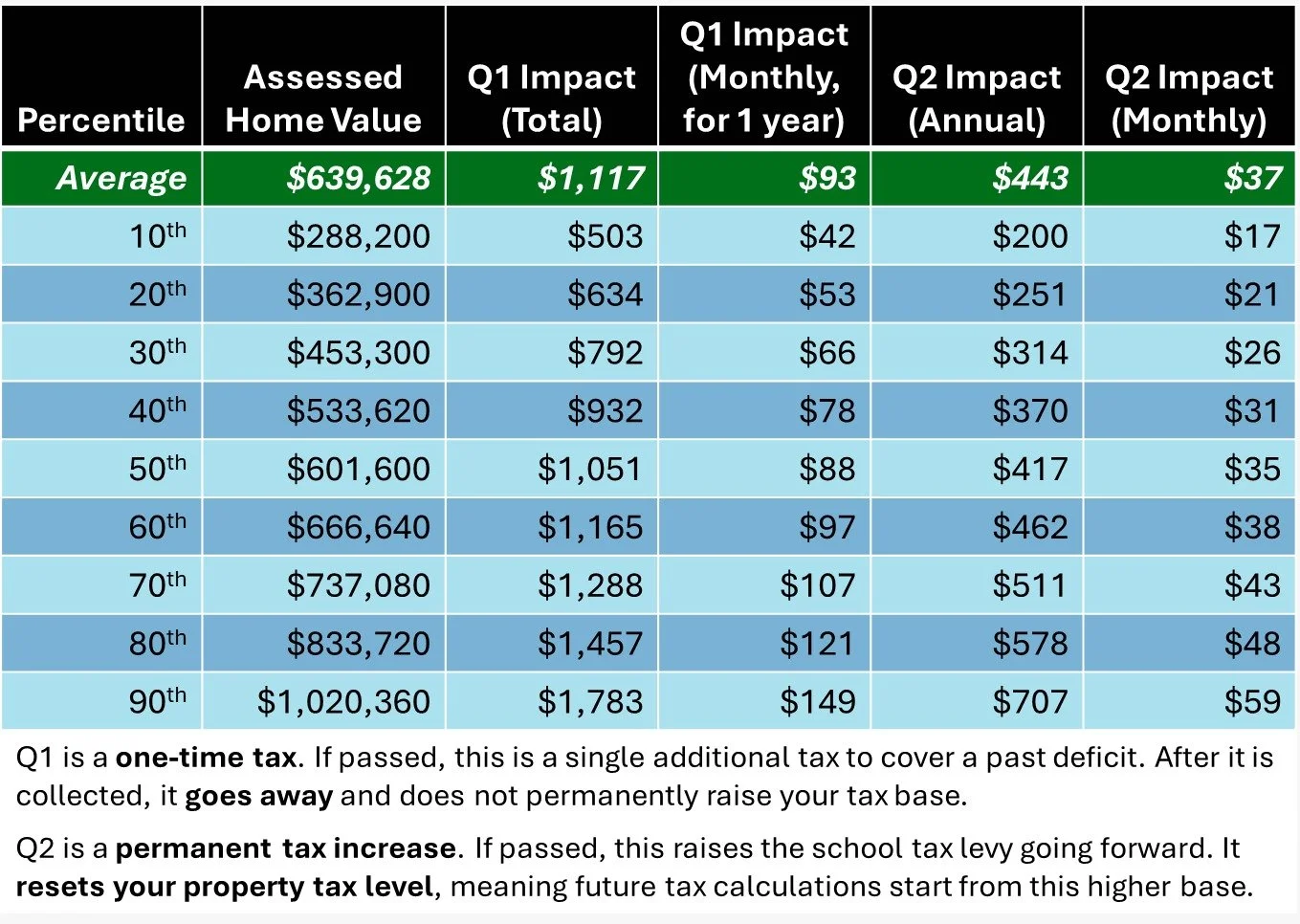
This table shows the impact of Yes votes on Q1 and Q2 on homeowners’ tax bills. A Yes vote on either question will result in a tax increase. The amount of the tax increase depends on your home’s assessed value. The numbers for the average homeowner have been shared widely, but everyone's individual picture will look different depending on the home’s assessed value.
While many homes in Montclair are selling for over $1 million, most homes are assessed for less. The chart below shows how the tax impact will vary based on the percentage of homes that fall within a grouping of assessed values (this table is based on a current assessed values, which will change with a reassessment, which Essex County has ordered must be in place by 2028).
The chart depicts only the potential increases due to the ballot measure, and does not cover other increases that could happen.
Using column 1, here’s how to read this table: 10% of homes in town are assessed at or below $288,200. The next 10% of homes are taxed between $288,200 and $362,900, and so on. The 90th percentile means that 10% of homes have an assessed value of at least $1,020,360.
Look up your home’s assessed value here.
Find the database used for this analysis here.
Author: Jason Bell
This table shows the impact of Yes votes on Q1 and Q2 on homeowners’ tax bills. A Yes vote on either question will result in a tax increase. The amount of the tax increase depends on your home’s assessed value. The numbers for the average homeowner have been shared widely, but everyone's individual picture will look different depending on the home’s assessed value.
While many homes in Montclair are selling for over $1 million, most homes are assessed for less. The chart below shows how the tax impact will vary based on the percentage of homes that fall within a grouping of assessed values (this table is based on a current assessed values, which will change with a reassessment, which Essex County has ordered must be in place by 2028).
The chart depicts only the potential increases due to the ballot measure, and does not cover other increases that could happen.
Using column 1, here’s how to read this table: 10% of homes in town are assessed at or below $288,200. The next 10% of homes are taxed between $288,200 and $362,900, and so on. The 90th percentile means that 10% of homes have an assessed value of at least $1,020,360.
Look up your home’s assessed value here.
Find the database used for this analysis here.
Author: Jason Bell